
We replaced a sewer line under a front lawn
A sewer line replacement, photographed: what the camera showed before anyone dug, why the lawn had to come up, and what the wall of the trench said about the roots that caused it.
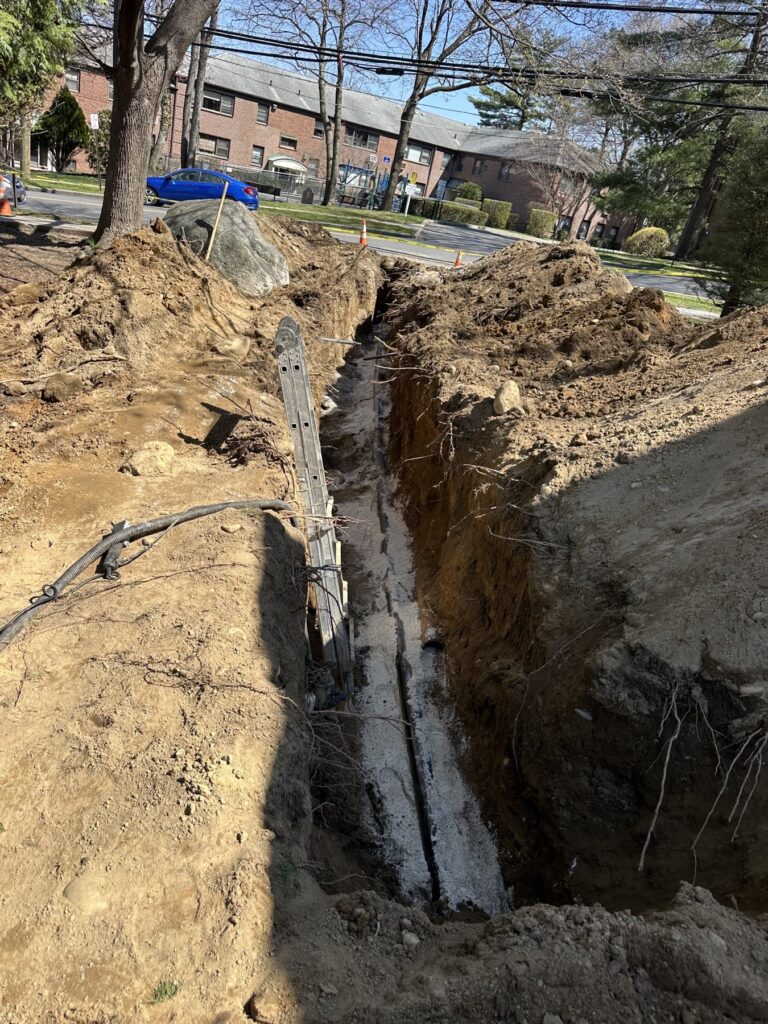
A drain that clears and then blocks again a month later is telling you something. Often the answer is drain cleaning and a look inside the line, and that is the end of it. Sometimes the answer is this one: the lawn has to come up.
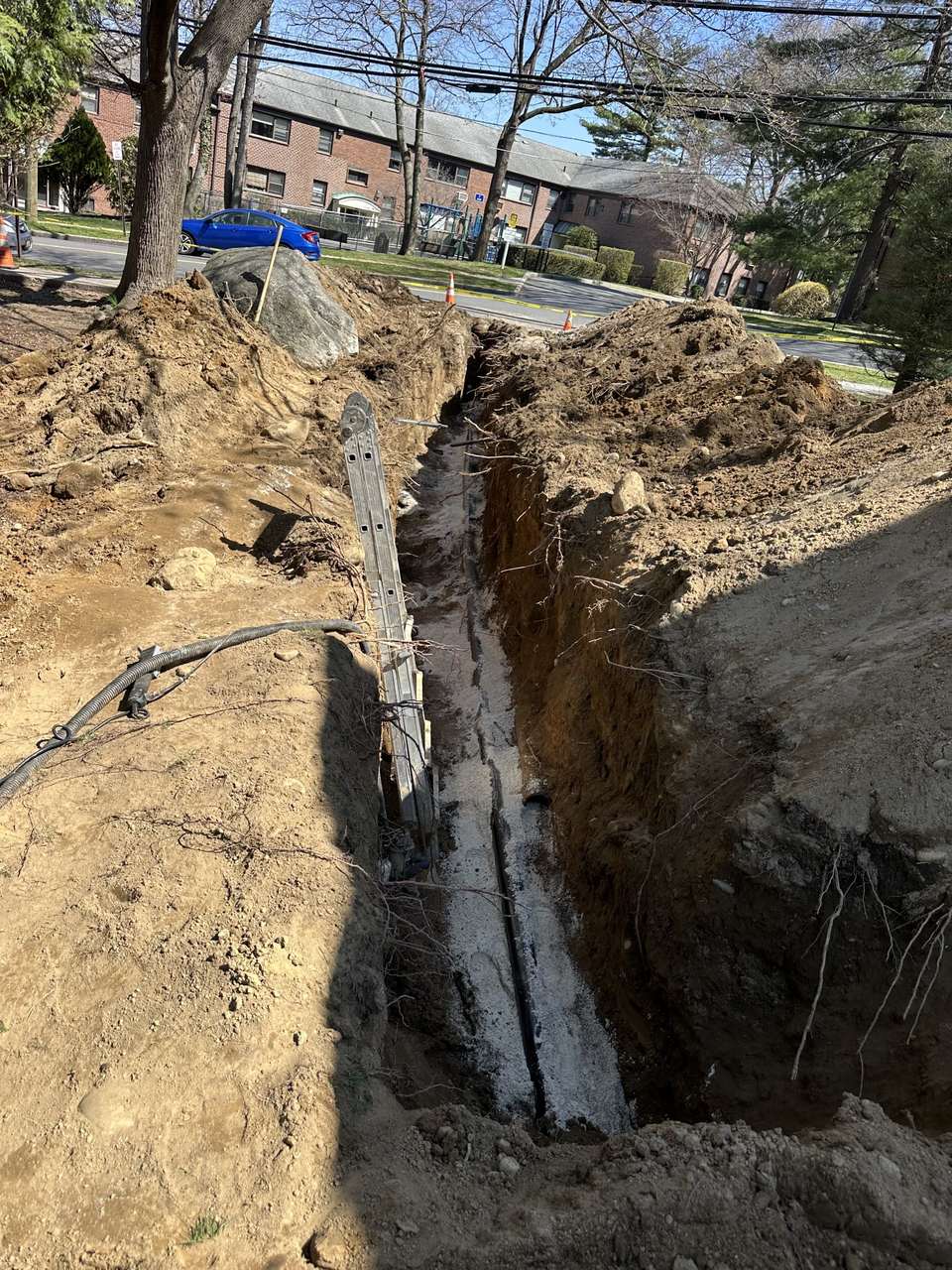
These photographs are from a sewer line replacement — the failed line out, a new one in, and an open trench running from the building out toward the main under the street. Here is how a job like this actually goes, and what the ground tells you while it is open.
The camera goes in before the shovel
We own our sewer camera, so nothing here gets dug on a hunch. The camera shows where the problem is, how far along the line it sits, how deep, and what kind of failure it is — roots at a joint, a cracked section, a belly holding water, or a pipe that has given up altogether.
That matters because the findings decide the method. A hydro jetting run clears grease and roots from a pipe that is still sound. A single broken section can sometimes be repaired on its own. A line that has lost its shape over a long run is a sewer line replacement, and that means excavation. It also decides the price, which is agreed with you before any work starts.
Why a sewer line replacement means opening the ground
A sewer line runs on a slope. It has to, because nothing pumps it — gravity does the work, and a fraction of an inch per foot is the difference between a line that clears itself and one that collects what passes through it. That slope has to be rebuilt exactly, along the whole run, which is why the whole run gets opened rather than patched in two places.
It is also deep. The trench in the photograph above is deep enough to need a ladder, which makes it a hole a person stands in with walls that can come down. That part is not decoration: the sides get cut back or supported, the spoil goes far enough from the edge not to load it, and nobody works in a trench alone.
What the trench wall tells you
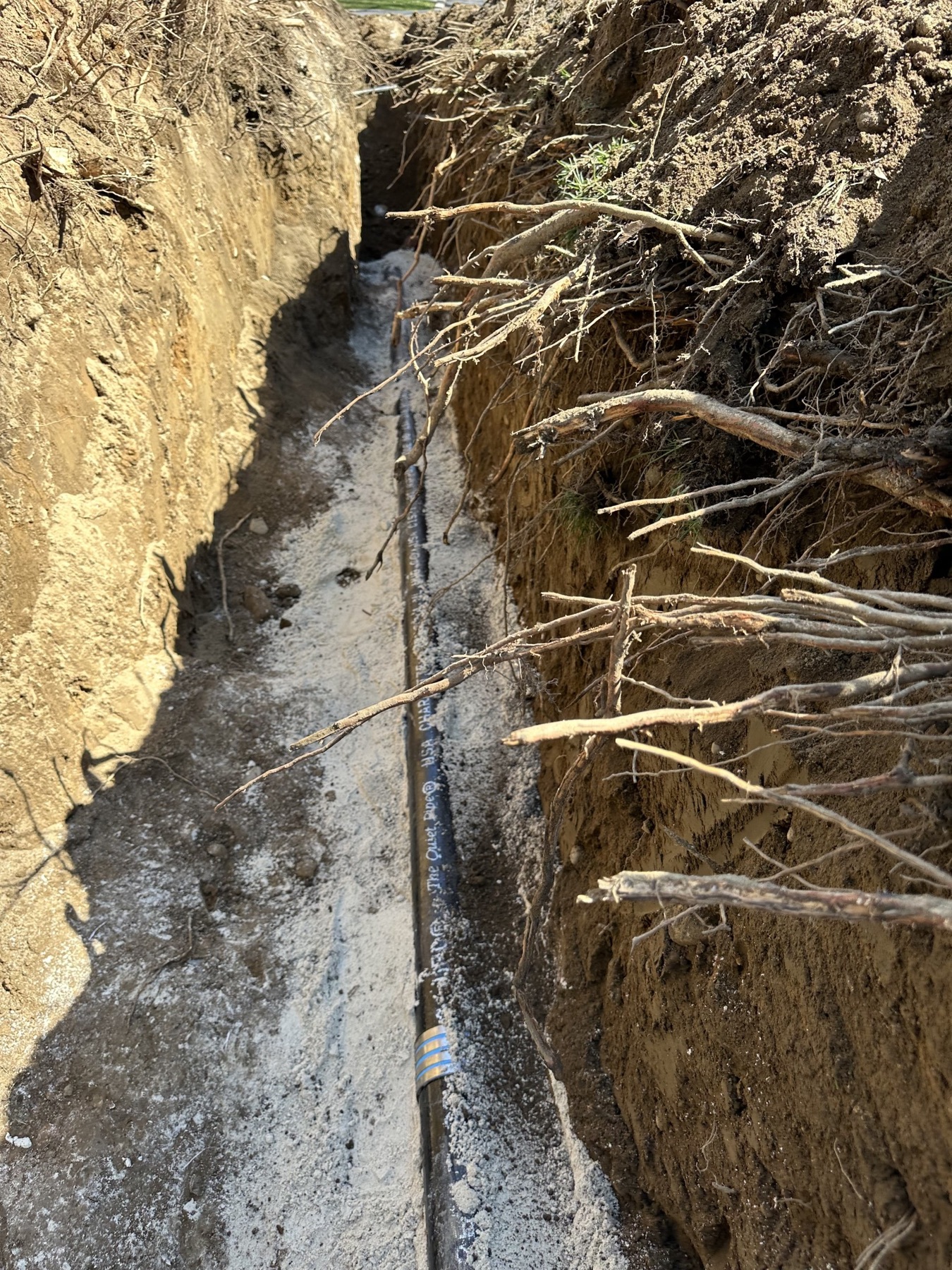
Roots. Not one taproot — a mat of them, cut clean through, at exactly the depth the old line ran. Roots do not break into a sealed, healthy pipe out of mischief. They follow moisture and air leaking from a joint that has already started to open, and once they are inside they thicken until they catch everything that goes past: wipes, paper, grease.
That is why a snaked line clears for a few weeks and then blocks again in the same place. The cable punches a hole through the root mass. The roots are still there, and so is the gap that let them in — and once enough joints have gone that way, clearing stops being the answer and a sewer line replacement starts being it.
Bedding, backfill, and the lawn afterward
The last part of a sewer line replacement is the part nobody photographs. New pipe does not go down on rubble or lumpy fill. It is bedded on sand, so it is carried evenly along its whole length and keeps the slope it was set to — you can see the pale bed under the new line in the second photograph. Backfill then goes in and gets compacted in layers rather than pushed back all at once.
Be ready for the ground to remember this for a while. Even well-compacted backfill settles over the following months, and the grass takes a season to stop showing where the trench ran. That is normal, and it is worth knowing before the first rain.
How to tell it is the main line, and not one drain
- Several fixtures slow down or back up at the same time, rather than just one
- Water comes up at the lowest point in the house — usually a basement floor drain or a first-floor shower
- Toilets gurgle when a tub or washing machine drains
- A sewage smell outside, around the run between the building and the street
- A strip of lawn that is greener, wetter or sinking slightly along the same line
Any of those is worth a camera inspection before it becomes an emergency. If it is already backing up, stop running water — every flush and every appliance cycle adds to what is coming back — keep people away from it, and call us.
What happens before anyone commits to digging
A sewer line replacement is planned work, not a decision made in a panic. The camera goes in first. You see what we found and what it means. Excavation is scoped and priced as its own piece of work, and the price is agreed before anything starts. If a building or board needs a certificate of insurance, we provide it beforehand. And where the line can be saved rather than replaced, sewer line repair is the cheaper answer and we will say so.
Where the owner’s part of the line ends depends on the town. In Yonkers, the city’s Water Bureau says many homeowners are responsible for the water and sewer service lines that run under their property, between the house and the city’s mains. In White Plains, the city’s site does not draw that line for a given property, so ask DPW about your address; what it does say is that it runs the sanitary sewer separately from the storm sewer and checks it for roof leaders, sump pumps and cellar drains feeding in, so anything like that tied into an old house line is worth finding while the trench is open.
Sewer trouble in Dobbs Ferry, Hastings-on-Hudson, Irvington, Yonkers or anywhere else in lower Westchester? Call KBD Plumbing & Heating at (914) 233-3000 — any hour, holidays included.
Services in this article
Sewer line repair
Sewer line repair across Westchester — the problem found on camera first, roots cut out, broken lines repaired, and excavation scoped project by project.
Sewer camera inspection
A sewer camera inspection shows what’s really happening inside the line — before a repair is priced, and before you buy a house.

Hydro jetting
Hydro jetting for Westchester drains and sewer lines — high-pressure water scours grease, scale and roots off the pipe walls, not just a hole through the clog.
5.0 from 4 customer reviews on Thumbtack
- Top Pro 2025 on Thumbtack
- Background checked
Terrific — smart, professional, honest. Very experienced problem solver. I was very impressed with his skills and troubleshooting ability.
Arrived on time, diagnosed the problem quickly and had everything repaired in no time. The work was clean and professional.
Based in Dobbs Ferry, across lower Westchester
Just outside these towns? Call anyway and we’ll tell you straight whether we can help.